Journal
Our Journal
Architectural CNC components

CNC Routing for Custom Architectural Millwork in Hawaiʻi
Curved architectural components are rarely as simple as they appear in a finished interior.
A sweeping stair, radius wall, curved reception desk, or sculpted transition may require several precisely related parts beneath the final surface. Each component must match the intended geometry and coordinate with the surrounding millwork.
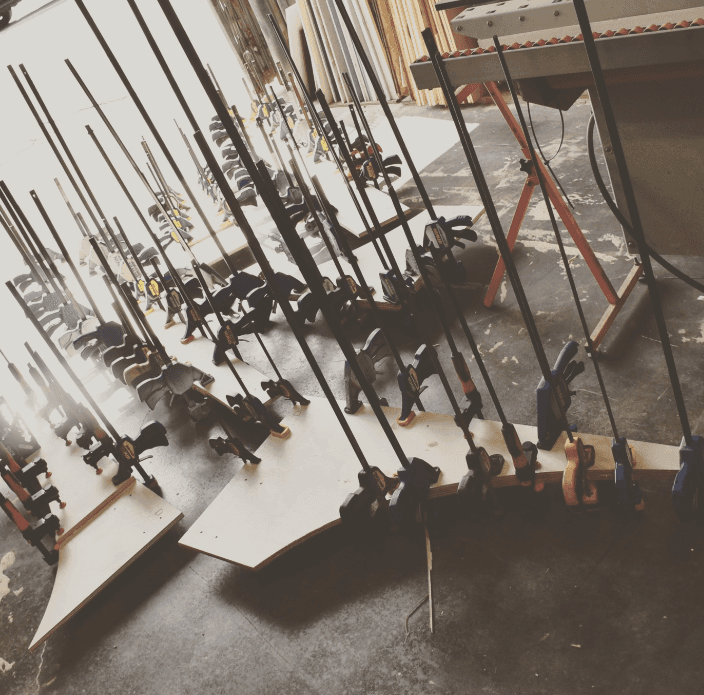
For this custom staircase project, CNC Wood Arts machined multi-radius components from MDF. The pieces required accurate curves and clean surfaces so they could support the next stages of assembly and finishing.

Why Curved Components Are Difficult to Produce
Traditional layout methods can produce curved parts, but compound or changing radii become increasingly difficult to reproduce by hand.
Small variations between components can accumulate during assembly. A curve that is slightly incorrect at one point may create alignment problems, uneven surfaces, or additional fitting work later.
Digital modeling and CNC routing create a controlled relationship between every component. Once the geometry is resolved, matching parts can be machined repeatedly from the same production files.

From Digital Geometry to Machined Parts
The process begins with the intended form. That information may arrive as architectural drawings, templates, dimensions, a 3D model, or a physical condition that must be translated into digital geometry.
Before machining, the design is reviewed for:
Material thickness
Finished radius
Joinery and alignment
Tool access
Part orientation
Assembly sequence
Allowance for final surfacing
Efficient use of sheet material
The components are then nested or positioned for machining and assigned the appropriate CNC operations.

Why MDF Was Used
MDF can be a practical material for templates, substrates, molds, curved assemblies, and components that will receive another finished surface.
Its uniform composition allows it to machine consistently without the changing grain direction found in solid wood. The material still requires an appropriate cutting strategy, reliable dust extraction, secure workholding, and tools selected for clean edges and efficient material removal.
For this staircase project, the machine’s rigidity and cut quality produced smooth multi-radius components with a strong surface finish directly from the CNC process.
Applications Beyond Staircases
This workflow can also be used for:
Curved walls and soffits
Reception desks and bars
Arches and portals
Radius cabinetry
Feature-wall substrates
Furniture components
Jigs and assembly fixtures
Molds and forming tools
Repeated millwork parts
For architects and designers, CNC production makes ambitious geometry more buildable. For contractors and millwork shops, it provides access to complex or repeatable components without requiring every part to be laid out and shaped manually.
Architectural CNC Routing in Hawaiʻi
CNC Wood Arts provides CNC routing, production engineering, and custom component fabrication for projects across Oʻahu and Hawaiʻi.
We can work from prepared production files or help develop early drawings into machinable geometry. Scope can include prototypes, one-off components, short production runs, assembly, and finishing depending on the project.
Send us your drawings, models, dimensions, material requirements, quantity, and schedule. We’ll review the geometry and recommend a practical route from design to fabrication.
CNC Routing for Custom Architectural Millwork in Hawaiʻi
Curved architectural components are rarely as simple as they appear in a finished interior.
A sweeping stair, radius wall, curved reception desk, or sculpted transition may require several precisely related parts beneath the final surface. Each component must match the intended geometry and coordinate with the surrounding millwork.
For this custom staircase project, CNC Wood Arts machined multi-radius components from MDF. The pieces required accurate curves and clean surfaces so they could support the next stages of assembly and finishing.
Why Curved Components Are Difficult to Produce
Traditional layout methods can produce curved parts, but compound or changing radii become increasingly difficult to reproduce by hand.
Small variations between components can accumulate during assembly. A curve that is slightly incorrect at one point may create alignment problems, uneven surfaces, or additional fitting work later.
Digital modeling and CNC routing create a controlled relationship between every component. Once the geometry is resolved, matching parts can be machined repeatedly from the same production files.
From Digital Geometry to Machined Parts
The process begins with the intended form. That information may arrive as architectural drawings, templates, dimensions, a 3D model, or a physical condition that must be translated into digital geometry.
Before machining, the design is reviewed for:
Material thickness
Finished radius
Joinery and alignment
Tool access
Part orientation
Assembly sequence
Allowance for final surfacing
Efficient use of sheet material
The components are then nested or positioned for machining and assigned the appropriate CNC operations.
Why MDF Was Used
MDF can be a practical material for templates, substrates, molds, curved assemblies, and components that will receive another finished surface.
Its uniform composition allows it to machine consistently without the changing grain direction found in solid wood. The material still requires an appropriate cutting strategy, reliable dust extraction, secure workholding, and tools selected for clean edges and efficient material removal.
For this staircase project, the machine’s rigidity and cut quality produced smooth multi-radius components with a strong surface finish directly from the CNC process.
Applications Beyond Staircases
This workflow can also be used for:
Curved walls and soffits
Reception desks and bars
Arches and portals
Radius cabinetry
Feature-wall substrates
Furniture components
Jigs and assembly fixtures
Molds and forming tools
Repeated millwork parts
For architects and designers, CNC production makes ambitious geometry more buildable. For contractors and millwork shops, it provides access to complex or repeatable components without requiring every part to be laid out and shaped manually.
Architectural CNC Routing in Hawaiʻi
CNC Wood Arts provides CNC routing, production engineering, and custom component fabrication for projects across Oʻahu and Hawaiʻi.
We can work from prepared production files or help develop early drawings into machinable geometry. Scope can include prototypes, one-off components, short production runs, assembly, and finishing depending on the project.
Send us your drawings, models, dimensions, material requirements, quantity, and schedule. We’ll review the geometry and recommend a practical route from design to fabrication.
Our Journal
Design Insights And Creative Perspectives

Monkeypod engraving
Exploring how thoughtful design shapes human experiences.
Monkeypod engraving
Exploring how thoughtful design shapes human experiences.

Three-dimensional hardwood carving
Exploring how thoughtful design shapes human experiences.
Three-dimensional hardwood carving
Exploring how thoughtful design shapes human experiences.
Architectural CNC components
Exploring how thoughtful design shapes human experiences.
Architectural CNC components
Exploring how thoughtful design shapes human experiences.
Monkeypod engraving
Exploring how thoughtful design shapes human experiences.
Monkeypod engraving
Exploring how thoughtful design shapes human experiences.
Three-dimensional hardwood carving
Exploring how thoughtful design shapes human experiences.
Three-dimensional hardwood carving
Exploring how thoughtful design shapes human experiences.
Architectural CNC components
Exploring how thoughtful design shapes human experiences.
Architectural CNC components
Exploring how thoughtful design shapes human experiences.

BUILT FOR TOMORROW
Exploring how thoughtful design shapes human experiences.
BUILT FOR TOMORROW
Exploring how thoughtful design shapes human experiences.

Contact Us
Have a complex idea? Let’s work through it.
Have a complex idea? Let’s work through it.
Let's bring your vision to life with thoughtful architecture, timeless design, and exceptional craftsmanship.

CNC Wood Arts
Advanced design and fabrication for architectural woodwork, sculptural forms, and precision components. A division of GavinWood in Kāneʻohe, Hawaiʻ
905 Kalanianaʻole Hwy
Kailua, HI, 96734
(808) 262-5941
(808) 262-5941
© 2026 CNC Wood Arts - A Gavinwood Company